SODERLINGEN
The Duchy of Soderlingen is the largest state of the Gottesreich, occupying a broad stretch of the Empire's southern frontier. The duchy is among the oldest constituent states of the Empire and played a central role in its original foundation. The double-headed eagle now used as the defining emblem of the Empire was originally the device of Soderlingen and was adopted by the early Gottesreich in recognition of the duchy's importance. This history remains a major source of Soderlinger pride and contributes to the duchy's fiercely independent political character.
Successive Emperors have consequently found Soderlingen difficult to govern. Its dukes are protective of their privileges, pursue their own interests aggressively and frequently resist outside interference. Nevertheless, outright Soderlinger betrayal of the Gottesreich is considered extremely unlikely. Soderlingers do not regard themselves as peripheral subjects of the Empire, but as descendants of one of the states which created it.
Much of central and northern Soderlingen consists of fertile valleys, rolling uplands, forests and productive farmland. Toward the south, the country rises dramatically into a continuous mountainous frontier separating Soderlingen from northern Valeria. Roads through these mountains are concentrated into a limited number of valleys and passes, many of which are heavily fortified.
The capital and largest city under ducal rule is Glückshofen, a wealthy and colourful city containing the ducal court, major churches, guildhalls, markets and a substantial population connected to the mercenary trade. The geographically larger city of Müren lies within Soderlingen but is politically independent as a Free Imperial City, answering directly to the Emperor rather than the Duke.
Kretz is the ancestral seat of House von Kretz, though otherwise of relatively modest political and commercial importance. It is famous throughout the Gottesreich as the birthplace of Kretzer Craps, an immensely popular dice game carried abroad by Soderlinger soldiers and now widely played in all corners of Diurdom and Valeria. Sigisburg, by contrast, is a heavily fortified southern city controlling one of the primary mountain approaches into the Valerian state of Bellonia and remains closely associated with the old County of Sigisburg.
Soderlinger military culture is overwhelmingly mercenary. Armies are commonly raised through professional captains and Landsknecht Free Companies, whose services may be hired by the Duke or by foreign lords. A company fighting for Soderlingen in one campaign may serve abroad in the next, and mercenary service has become one of the duchy's most important professions.
The distinctive Soderlinger military style of bright colours, puffed and slashed clothing, flamboyant equipment and the tradition of the Doppelsöldner originated within these companies before spreading elsewhere through mercenary service. Soderlinger Free Companies are also among the few organized military formations within the Gottesreich that openly permit women to enlist as ordinary soldiers. Successful captains and veterans may return home with considerable wealth, giving military service an unusual degree of social mobility.
Soderlingen is firmly Diurnist, while the Valerian territories beyond its southern mountains remain predominantly Panopleist. The resulting religious divide has contributed to centuries of hostility along the frontier, compounded by disputes over passes, border lordships, tolls and territory. Sigisburg and the southern fortresses consequently hold particular importance as guardians of the Diurnist frontier.
Relations with Bodenburg are generally close and cooperative, strengthened by trade, military cooperation and noble connections. Relations with Savobourg are more competitive, particularly between their respective mercenary traditions, while relations with Österland remain politically useful but somewhat strained. Soderlingen nevertheless cooperates with both when broader Imperial interests align.
Soderlinger towns are characteristically southern Kernish in appearance, with plastered and painted masonry houses, steep tiled roofs, broad market streets, guildhalls, fountains, fortified gates and substantial Diurnist churches. Bright colours are common in both civilian dress and architecture. The countryside is marked by prosperous farming villages, cattle country, woodland, monasteries and roadside shrines, becoming increasingly mountainous toward the south.
Soderlingen retains its own traditional reckoning of time, the Saint Veitern Calendar. By Soderlinger reckoning the present year is 1523, while most of the Empire records the year as 1475.
Local Superstition: Toast of Remembrance
Among Soderlinger Landsknechte, Kriegsknechte, militia and veterans, a toast is traditionally followed by tapping the bottom of the cup once against a table or other sturdy surface before drinking. The gesture is made in remembrance of fallen comrades who are no longer present to raise their own cups.
Local Festival: Saint Veitern’s Day
Saint Veitern’s Day is one of Soderlingen’s greatest annual celebrations and the feast of the saint from whom the Saint Veitern Calendar takes its name. Towns are decorated with brightly coloured cloth and banners, and the day is marked by Mass, processions, music, dancing, drinking and public feasting. In Glückshofen, guilds and Landsknecht companies parade through the city in their finest colours, making the feast particularly famous for its extravagant dress and display.
THE IMPERIAL DUCHY OF SODERLINGEN

The Territorial Arms of Soderlingen

Political Map of Soderlingen
Capital
and largest city
Glückshofen
Official Language
-
High Kernish (Early New High German)
Common Languages
-
Common Vernacular (Modern English)
-
Low Kernish (Middle Low German)
-
North Valerian (Fictional Dialect)
Government
Hereditary Feudal Duchy
Reigning Lord
Otto von Kretz
Titles
Prince-Elector of the Gottesreich, Duke of Soderlingen, Count of Sigisburg, Lord of Kretz
Religion
Church of the Divine Diurnity
Denomination
Imperial Diurnism
Demonym
Soderlinger
Currency
Imperial Gilschen
Valerian Gilly
Calendar
Saint Veitern Calendar
Date: 1523
Notable Cities & Fortifications
Rottweiln
Horben
Dinkeldorf
Kretz
Sigisburg
LIFE IN SODERLINGEN
Food & Drink
Soderlinger food is hearty and well suited to a country of farms, cattle country, market towns, and travelling soldiers. Dark and wheat breads, sausages, pork, smoked meats, cabbage, onions, peas, eggs, cheese, dumplings, and thick porridges are common. Cattle country provides milk, butter, and cheese in abundance, while southern mountain communities make greater use of preserved meat and foods capable of surviving long winters.
Ale remains the ordinary drink of households and taverns. Drinking is an important part of social life, particularly among soldiers, craftsmen, and travelling companies, and Soderlinger taverns have a reputation abroad for being loud places. This reputation is not entirely undeserved, though foreigners often exaggerate it considerably.
Soldiers on campaign rely heavily upon bread, cheese, sausage, dried or smoked meat, and whatever can be purchased locally. Many foods associated abroad with Soderlinger mercenaries are simply ordinary travelling fare carried far beyond the duchy by its soldiers.
Work & Trade
Agriculture supports most of the population, with grain farming, cattle raising, forestry, milling, and animal husbandry widespread throughout the central and northern countryside. Mountain communities add timber cutting, mining, herding, and the maintenance of the roads and passes leading toward Valeria.
What distinguishes Soderlingen is the sheer number of livelihoods connected to mercenary service. Captains, recruiters, armourers, weapon-makers, tailors, cobblers, farriers, wagoners, laundresses, sutlers, scribes, lenders, and tavern keepers all profit from the constant raising and movement of Free Companies.
For many households, soldiering is simply another trade. A parent, sibling, spouse, or grown child may spend several years abroad and return with foreign coin, clothing, weapons, and stories. Successful soldiers sometimes use their earnings to purchase property, establish businesses, or enter respectable urban society.
Language & Speech
Soderlingers speak Kernish, with a strong southern character readily recognized elsewhere in the Gottesreich. Mercenary service has also introduced a considerable amount of foreign vocabulary into soldiers' speech, particularly terms picked up in Beaugencie, Valeria, Albelond, and other lands where Soderlinger companies have served.
Soderlinger conversation has a reputation for being loud, expressive, and informal, particularly among soldiers. Boasting, joking, gambling talk, and elaborate insults are common in military company, although behaviour considered amusing in a barracks or tavern may be inappropriate before a guildmaster, priest, or noble.
Free Companies develop considerable slang of their own. Veterans may identify another company's origin or history simply from its expressions, marching songs, dress, or the particular way its soldiers curse.
Courtesy & Etiquette
Soderlinger hospitality is generally generous and informal. A visitor is likely to be offered food and ale quickly, and refusing to join a household or company for a drink without explanation can seem unfriendly. Rank still matters, particularly around nobles and officers, but everyday social interaction tends to be less ceremonious than in Pontz.
Among soldiers, companionship carries its own etiquette. Sharing food, watching another soldier's equipment, settling agreed gambling debts, and refusing to abandon a companion without good cause are all taken seriously even by men and women who otherwise appear unruly.
The Toast of Remembrance belongs particularly to this military world. Landsknechts, soldiers, and veterans traditionally strike their cups together and then tap the bottoms once against the table before drinking, remembering comrades no longer present to raise their own.
Everyday Religion
Soderlingen is firmly Diurnist, and religious practice remains conspicuous even among its famously unruly mercenaries. Towns and villages contain numerous shrines, chapels, churches, and religious images, while mountain roads are frequently marked by small roadside shrines where travellers may pray before attempting a difficult pass.
Soldiers commonly carry inexpensive devotional tokens, make the Sign of the Sun before battle or a dangerous journey, and give offerings after surviving a campaign. A mercenary who drinks, gambles, swears, and spends his wages recklessly may nevertheless take Mass, confession, relics, and the ringing of bells entirely seriously.
The Panopleist lands beyond the southern mountains give religion a particularly strong significance around Sigisburg and the frontier. Even Soderlingers who give little thought to theology may understand themselves very clearly as Diurnists when confronted by Valerians.
What a Soderlinger Knows
Someone raised in Soderlingen would normally recognize the double-headed eagle both as the ancient device of Soderlingen and as the emblem subsequently adopted by the Gottesreich. Most also understand the unusual position of Müren: geographically surrounded by Soderlinger country, yet politically a Free Imperial City beyond the Duke's direct authority.
The Saint Veitern Calendar is second nature. A Soderlinger knows that the year is 1523 at home and 1475 by the reckoning used through most of the Gottesreich, and merchants, soldiers, and travellers quickly learn to convert between the two when dating contracts or letters.
Most Soderlingers also know at least the basic rules of Kretzer Craps, whether or not they gamble regularly. Soldiers and townspeople can recognize the banners or colours of prominent Free Companies, while those living in the south know which mountain passes remain usable in bad weather and which roads become dangerous after the first heavy snows.
Coin flows almost as freely as ale in the cities of Soderlingen. Mercenaries return from foreign service carrying whatever tender they were paid in, and foreign coins are routinely spent in taverns, markets, and shops without attracting much notice. Most Soderlingers could not identify the origin of every unfamiliar coin they encounter, but judging its approximate value from its size and weight is a practical skill widely learned through everyday trade.
Ordinary Troubles
Soderlinger troubles frequently follow soldiers wherever they go. Unpaid wages, disputed contracts, gambling debts, drunken quarrels, fraudulent recruiters, desertion, stolen equipment, and fights between rival companies are familiar problems in towns where mercenaries gather.
The presence of large numbers of armed people can create friction even when no war is being fought. A company waiting for employment still needs food, lodging, ale, horses, and money, and disagreements between soldiers and townspeople can quickly become serious if captains or civic authorities fail to keep order.
In the south, smuggling, cattle theft, disputed tolls, raids through mountain passes, and quarrels with Valerian border communities remain persistent concerns. Elsewhere, ordinary Soderlinger life produces the same smaller disputes found across the Empire: inheritance arguments, guild conflicts, debts, damaged crops, property boundaries, and disagreements between neighbours.

A Landsknecht Free Company Captain
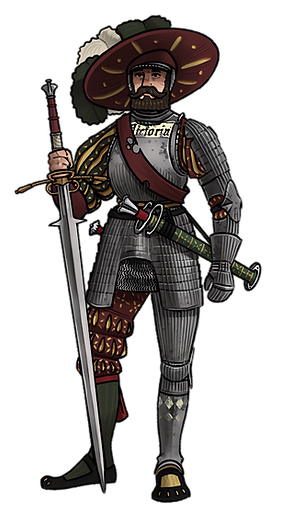
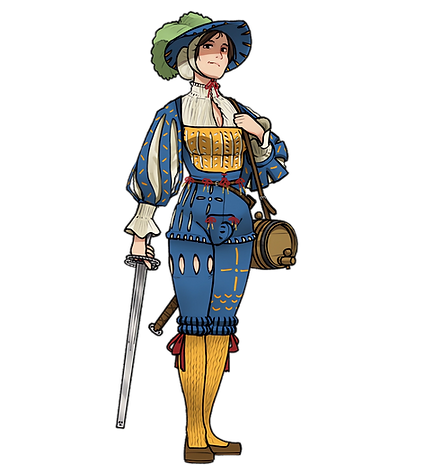
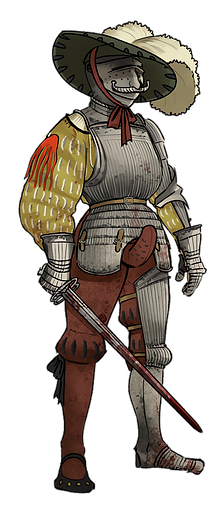
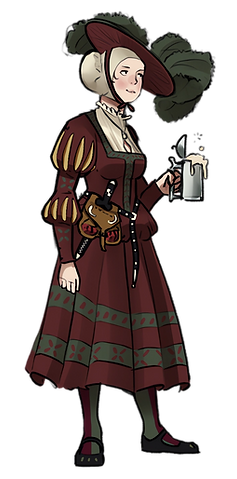
A Doppelsöldner and his wife, a female Landsknecht and a Soderlinger Knight, all in stereotypical Soderlingen clothing and armour.