PONTZ
Pontz is a wealthy and aggressive territory spanning the frontier between the Gottesreich and the Kingdom of Beaugencie. Its eastern lands withinin the Gottesreich form the Principality of Pontz (also known as Imperial Pontz), while its western lands within Beaugencie constitute the Duchy of Pontz (also known as Gennish Pontz). Though belonging to separate realms, both are held by the House d’Ault and presently ruled by John of Pontz, Prince and Duke of Pontz.
The two halves of Pontz remain legally distinct. As Prince of Pontz, John is a vassal of the Emperor of the Gottesreich, and as Duke of Pontz, he is a vassal of the King of Beaugencie. His authority therefore crosses a political frontier, leaving the House d’Ault beholden to two sovereigns through two separate titles. Both Principality and Duchy are together regarded simply as Pontz, bound by the same dynasty, commerce and common Pontish identity.
Much of Pontz’s wealth and importance comes from the Runk, a great river which serves as one of the principal gateways between Beaugencie and the Gottesreich. Merchants, travellers and armies passing between the two realms frequently move through Pontish territory, enriching the towns and lordships commanding its roads, bridges and river crossings. Control of this passage has long been central to Pontish power.
Beyond the Runk, Pontz is a fertile country of rolling pastures, river valleys, cultivated highlands and extensive vineyards. Wine is among its most celebrated exports, carried along the river and traded widely throughout both neighbouring realms. Particularly prized is Pontish Blanc, a crisp, pale white wine produced in the vineyards surrounding the city of Saverne in the highlands of southern Pontz.
The country is equally renowned for its craftsmen. Pontish armourers produce fine harness for wealthy men-at-arms, while its saddlers and tack masters are especially celebrated for the quality of their war tack. Fine armour, costly horses and elaborate equipment are conspicuous features of the Pontish nobility, whose wealth supports a strong tradition of mounted warfare.
The greatest city of Pontz is Breux, its foremost centre of commerce and manufacture. Martz and Saverne are the other principal cities of Imperial Pontz, while Valonne is among the principal cities of the Gennish Duchy. Together these cities command much of the commerce passing between the interior of Beaugencie and the western Gottesreich.
Centuries upon the frontier have given Pontz a character distinct from either of its neighbours. Kernish and Beauçais are both spoken within its lands, with Kernish predominating in Imperial Pontz and Beauçais in the Gennish Duchy. Imperial and Gennish influences intermingle in its architecture, dress, cuisine and aristocratic customs, while noble and mercantile families commonly maintain connections on both sides of the frontier. Pontish towns are particularly recognizable for their steep roofs with elaborate patterns of coloured glazed tile.
John of Pontz
The present ruler, John d’Ault, is ordinarily known by his territorial style as John of Pontz. He holds two distinct dignities, Prince of Pontz within the Gottesreich and Duke of Pontz within Beaugencie, placing him among the great lords and in the peerage of both realms. Chroniclers also know him as John the Claviger. This epithet derives from the arms of the House d’Ault, which bear two crossed golden keys upon a red field. Crossed keys have consequently become closely associated with Pontish authority, appearing in white upon the banners and liveries of Pontish soldiers. The keys' symbolism to Pontz’s own political position have not gone unnoticed. Pontz commands the metaphorical gateway between Beaugencie and the Gottesreich, lending the old sigil a new significance under John’s rule as a state which holds the keys to the Empire.
Pontish policy is characteristically self-interested. Its rulers cultivate alliances where they are advantageous and have rarely hesitated to employ wealth, diplomacy or force in pursuit of their own self interests. Its command of the Runk, prosperous towns, valuable industries and well-equipped military allow Pontz to exert considerable influence beyond its small borders and punch above it's weight in conflict.
Despite the political frontier running through it, Pontz remains one country in the minds of the Pontish. Principality and Duchy are bound together by dynasty, commerce and a common identity, regardless of their differing obligations to crown and empire. Whoever commands Pontz commands one of the principal passages between Beaugencie and the Gottesreich. Under John of Pontz, the crossed keys have become an apt emblem for those who command the gate.
Local Superstition: Spilled Wine
In Pontz, it is considered bad luck to wipe up wine spilled during a meal before the table has been cleared. The wine is left until the meal has ended, as cleaning it away prematurely is said to “wipe away the company,” foretelling that those gathered will never all meet around the same table again. The saying “Don’t wipe away the company” has consequently entered Pontish speech and may also be used when someone threatens to spoil an otherwise pleasant gathering.
Local Festival: The Grand Tourney of Breux
Each year, Breux hosts a prestigious tournament of melees, jousts and worships of arms which draw knights, nobles and visitors from across all of Diurdom and beyond. The tournament is accompanied by markets, feasting, horse trading and public entertainments that fill the city for the duration of the festivities. Knights from both Imperial and Gennish Pontz compete in the lists, making the Breux Tourney one of the most visible celebrations of their shared Pontish identity.
THE PRINCIPALITY AND DUCHY OF PONTZ

The Arms of House d'Ault

Political Map of Pontz
Capital
and largest city
Breux
Official Language
-
Pontish Kernish (Fictional Dialect)
-
Pontish Beauçais (Fictional Dialect)
Common Languages
-
Common Vernacular (Modern English)
-
High Kernish (Early New High German)
-
Low Kernish (Middle Low German)
-
Beauçais (Middle French)
Government
Hereditary Feudal Principality & Duchy
Reigning Lord
John of Pontz (John the Claviger, John d'Ault)
Titles
Prince-Elector of the Gottesreich, Prince of Imperial Pontz, Duke of Gennish Pontz, Count of Breux, Lord of Ault
Religion
Church of the Divine Diurnity
Denomination
Imperial Diurnism
Western Diurnism
Demonym
Pontish
Currency
Pontish Gilly
Calendar
Imperial Calendar
Date: 1475
Notable Cities
Martz
Saverne
Valonne
LIFE IN PONTZ
Food & Drink
Ordinary Pontish food is substantial rather than elaborate: dark and mixed-grain breads, pork, sausages, river fish, onions, cabbage, beans, seasonal fruit and especially cheese, which is eaten across all levels of society. Wine is the everyday drink of much of the country, particularly in the south and west, and even modest households may keep inexpensive local wine for meals. Better wines, especially Pontish Blanc from around Saverne, are a point of regional pride. Wine, sausage and cheese together are among the most characteristically Pontish things to place before a guest.
Work & Trade
Most Pontish families still live from agriculture, vineyards or livestock, but the Runk creates occupations uncommon in more landlocked territories. Boatmen, bargemen, ferrymen, warehouse labourers, coopers, carters, toll collectors and merchants are familiar sights throughout the river country. Pontz is also known for skilled saddlers, tackers, armourers and other craftsmen serving the military and horse trade. In the vineyard districts, pruning, harvesting, pressing and cooperage employ entire communities during the appropriate seasons.
Language & Speech
A Pontish traveller may hear both Kernish and Beauçais in the course of a single day's journey. Beauçais predominates farther west, Kernish farther east, and mixed communities are common in the central river country. Merchants, innkeepers and boatmen frequently know enough of both languages to conduct business. As a consequence, the Pontish dialect and accent is an interesting blend of both languages.
Pontish speech is generally regarded as polite and restrained by neighbouring peoples. Habitual cursing, shouting and coarse language are looked down upon, particularly in company, and even common people are usually taught the expected courtesies of greeting, leave-taking and formal address. In addition to Old Imperial (Ecclesiastical Latin), Pontish nobility is commonly expected to be fluent in Pontish Kernish, Kernish, and Beauçais.
The superstition surrounding spilled wine has also entered everyday speech: “Don't wipe away the company” may be said literally at the table, but is equally used when someone threatens to spoil an otherwise pleasant gathering.
Courtesy & Etiquette
Pontish society places considerable value on good manners and pleasant company. A person need not be wealthy or educated to understand how to bow properly, when to remove a hat, or how to address the local nobility. Commonfolk generally know the correct forms of address for the lords, knights and officials they are likely to encounter, and obvious discourtesy toward a social superior is considered embarrassing as much as insolent.
Hospitality follows the same pattern. An expected visitor is normally offered something to drink and, where possible, something to eat; wine and cheese are particularly common. Meals are often communal affairs among households, workshops and travelling companions, and maintaining good company at the table is considered a virtue in itself.
Pontish people are also somewhat accustomed to strangers. Merchants, soldiers, pilgrims, carters and travellers constantly move between Beaugencie and the Gottesreich, particularly along the Runk. A foreign accent therefore attracts less attention in Breux or the river towns than it might in an isolated inland village.
Everyday Religion
Pontish Diurnism is generally conventional and practical. Small roadside shrines, parish bells and devotional tokens are common, and travellers frequently make the Sign of the Sun when beginning a journey or crossing into unfamiliar country. River communities give particular attention to prayers before dangerous crossings or journeys downstream, while vineyard communities commonly seek blessings upon the harvest.
Bells remain an ordinary part of daily life. Their tolls mark hours, worship, death and emergencies, and most Pontish people can distinguish the familiar bells of their own parish or town without conscious effort.
What a Pontish Person Knows
Someone raised in Pontz ought reasonably know how to recognize the crossed golden or white keys associated with House d'Ault, understand the basic difference between Imperial and Gennish Pontz, and have at least a rough sense of which language is likely to be spoken farther east or west. Most would know which roads and riverbanks are prone to flooding, when the grape harvest begins locally, how to tell obviously spoiled wine from drinkable wine, and why spilled wine must remain untouched until the table is cleared.
They would also know the difference between a Pontish Gilly and an Imperial Gilschen. The two currencies exchange at one for one, so the practical distinction lies chiefly in their appearance and place of minting rather than their value.
Ordinary Troubles
Most Pontish problems are small and local rather than political. Flooded roads, damaged vineyards, disputed tolls, stolen horses, smuggling across the political boundaries of Pontz, quarrels over river access and arguments about debts are all familiar sources of conflict. Along the Runk, cargo theft and dishonest toll-taking are persistent concerns. In the countryside, disputes over vineyard boundaries, grazing rights and inheritance can divide neighbouring families for generations.
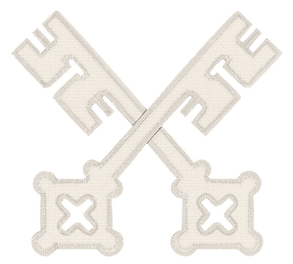
A cloth livery badge of the Crossed Keys of Pontz, worn in various ways by Pontish Soldiers

A Pontish Man-at-Arms


A military encampement set up outside a Pontish Château. Note the multi-coloured and patterned tile roof of the building, a distinctive feature of Pontish architecture.