LIDESBACH
The Duchy of Lidesbach is an Imperial territory lying east of Pontz and north of Brevia-Landau. A fertile country of broad valleys, rolling farmland and low wooded ridges, Lidesbach is moderately prosperous by the standards of the Gottesreich. Its inhabitants are known as Lidesbachers and predominantly speak High Kernish.
Agriculture forms the foundation of the Lidesbacher economy, supplemented by livestock, woodland resources, local crafts and a healthy overland trade with neighbouring territories. The duchy's productive countryside and prosperous towns make it somewhat wealthier than Brevia-Landau, although it possesses little of the commercial wealth associated with Pontz.
The traditional capital is Münzburg, seat of the ducal court and the political and administrative centre of the duchy. The larger city of Sankt Odel, however, is its principal centre of commerce and manufacture. Its markets, guilds and merchant houses give it considerable influence within the duchy. Hollen is another of Lidesbach's principal towns.
Lidesbach is ruled by House von Dessel, whose present head is Ludwig von Dessel, Duke of Lidesbach. Ludwig is a politically minded ruler with a strong interest in law, diplomacy and the preservation of his family's hereditary rights. Though an experienced military leader when necessary, he is less personally martial than his southern rival, Götz von Kesselried.
The rivalry between Lidesbach and Brevia-Landau stretches back generations. Following the extinction of the former ruling line of Brevia, both House von Dessel and House von Kesselried advanced strong claims to the county. The Emperor ultimately invested the Kesselrieds with Brevia, a settlement the von Dessels never fully accepted. What began as a succession dispute has since developed into a long history of feuding, raids and intermittent warfare between the two duchies.
Lidesbacher armies are consequently well accustomed to campaigning, though their military traditions differ somewhat from those of their Brevian rivals. Alongside the usual knights, men-at-arms and infantry, Lidesbach makes considerable use of light cavalry and mounted crossbowmen, particularly for scouting, raiding and harassment. The wealth of its towns also allows the dukes to draw upon well-equipped urban militias when required.
Relations with Pontz are commercially active but politically cold. Pontish merchants are common in Lidesbach, particularly in its western towns, but the close alliance between Pontz and Brevia-Landau remains a persistent source of distrust. Relations with Aulberg and Österland are considerably less contentious and are characterized chiefly by ordinary trade, noble connections and occasional disputes over local rights.
Lidesbach is among the more conspicuously Kernish territories of the region in its architecture and material culture. Its towns are characterized by steep gabled roofs, dense timber-framed streets, projecting upper storeys, tiled roofs and substantial market squares surrounded by guildhalls, inns and merchants' houses. Sankt Odel displays this urban character most strongly, while Münzburg retains the more aristocratic appearance of an old ducal capital, dominated by its castle, churches and noble residences.
Despite its long rivalry with Brevia-Landau, Lidesbach is not defined solely by warfare. Its prosperous towns, influential guilds and comparatively developed civic institutions give the duchy a strong urban character alongside its traditional landed nobility, distinguishing it from the more rural and martial country immediately to its south.
Local Superstition: Empty Chair
In Lidesbach, it is considered unlucky to leave an empty chair or stool pulled away from the table, as doing so is said to invite an unwanted visitor into the household. Before retiring, Lidesbachers traditionally push unused chairs neatly beneath the table, a habit observed even by those who put little faith in the superstition. The expression “You’ve left the chair out” is consequently used when someone is needlessly inviting trouble.
Local Festival: Saint Odel's Day
Each year, the city of Sankt Odel celebrates Odelstag, the feast of Saint Odel, an early Diurnist martyr and patron of the city. The day begins with Mass and a procession bearing a relic of the saint through the streets, followed by guild companies marching beneath their banners. Markets, competitions, music, feasting and drinking continue throughout the day, making Odelstag one of the largest annual celebrations in the duchy.
THE IMPERIAL DUCHY OF LIDESBACH

The Territorial Arms of Lidesbach
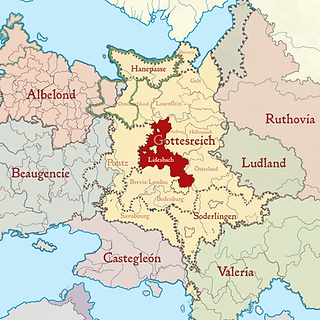
Political Map of Lidesbach
Capital
Largest City
Münzburg
Sankt Odel (Saint Odel)
Official Language
-
High Kernish (Early New High German)
Common Languages
-
Common Vernacular (Modern English)
-
Low Kernish (Middle Low German)
Government
Hereditary Feudal Duchy
Reigning Lord
Ludwig von Dessel
Titles
Duke of Lidesbach, Count of Hollen, Lord of Dessel
Religion
Church of the Divine Diurnity
Denomination
Imperial Diurnism
Demonym
Lidesbacher
Currency
Imperial Gilschen
Calendar
Saint Odel's Calendar
Date: 1494
Notable Cities & Fortifications
Hollen
Dessel
LIFE IN LIDESBACH
Food & Drink
Lidesbacher food is varied but generally hearty. Rye and wheat breads, sausages, pork, cabbage, onions, peas, eggs, cheese, and porridge are common, while apples, pears, and other orchard fruits appear frequently in season. Town bakeries are especially prominent, and prosperous households may purchase much of their bread rather than baking entirely at home.
Ale is the ordinary drink in households, inns, and taverns. Wine is readily available through trade with Pontz and other southern territories, particularly in the larger towns, but remains more expensive and less central to everyday life than ale.
Market days bring a much greater variety of food into the cities, and inhabitants of Sankt Odel are accustomed to stalls selling produce, meat, baked goods, cheeses, preserved fish, and goods brought in from surrounding villages.
Work & Trade
Agriculture remains the livelihood of much of the population, but Lidesbach has a larger urban and commercial class than neighbouring Brevia-Landau. Farmers, herdsmen, millers, foresters, and carters remain common, while the towns support large numbers of bakers, butchers, brewers, tailors, shoemakers, smiths, leatherworkers, merchants, clerks, and guild craftsmen.
Sankt Odel is the principal commercial and manufacturing centre of the duchy. Apprentices and journeymen are a familiar part of city life, and many families maintain connections to a particular trade across several generations.
Overland commerce is important throughout Lidesbach. Merchants, wagoners, horse dealers, toll officials, and travelling craftsmen move regularly between Sankt Odel, Münzburg, Pontz, Aulberg, Österland, and the smaller market towns of the duchy.
Language & Speech
Lidesbachers speak High Kernish, with differences in accent and vocabulary between towns and countryside. Urban speech, particularly in Sankt Odel, is sometimes regarded by rural inhabitants as quicker and more affected, while townsfolk may mock country speech as old-fashioned.
Lidesbachers generally place value on speaking clearly and knowing one's business. Merchants and craftsmen are accustomed to bargaining, discussing prices, and settling practical matters directly, although open shouting and needless public quarrelling are poorly regarded in respectable company.
Written notices, guild marks, seals, shop signs, and posted regulations are common features of urban life. Even people who cannot read often learn to recognize the marks and symbols of familiar guilds, merchants, and authorities.
Courtesy & Etiquette
Lidesbacher manners are generally orderly rather than elaborate. People are expected to greet others properly, respect one's place in another person's household or workshop, and avoid causing a public disturbance. In the towns especially, there is a strong expectation that business should be conducted fairly and agreements honoured.
Guests are normally offered ale or food when circumstances permit, though hospitality is somewhat less ceremonious than in Pontz. In workshops and merchant households, visitors are expected not to interfere with work unnecessarily, and arriving during a busy market or production day may earn a much shorter welcome than at another time.
A well-known superstition concerns the household table. An empty chair should never be left pulled away from the table overnight, as doing so is believed to invite an unwanted visitor into the home. The expression “You've left the chair out” is consequently used when someone is inviting unnecessary trouble.
Everyday Religion
Diurnism is closely woven into town and village life. Parish churches, bells, roadside shrines, household devotions, and religious guilds are common, while charitable gifts to churches, hospitals, and poor relief form a visible part of respectable civic life.
The cult of Saint Odel is particularly important in Sankt Odel, whose principal church gave the city its name. His feast, Odelstag, draws pilgrims, merchants, guild companies, and visitors from throughout the duchy, but devotion to the saint extends beyond the festival itself. Urban guilds commonly maintain their own candles, devotional images, or charitable obligations, and many craftsmen attend Mass collectively on important feast days.
What a Lidesbacher Knows
Someone raised in Lidesbach would normally recognize the arms of House von Dessel and know whether his home lies under the direct authority of the Duke, a lesser lord, or a town government. Townspeople in particular are usually familiar with the guilds and trades represented in their neighbourhood.
A Lidesbacher raised in or near a town would know the meaning of common market bells, where particular trades traditionally sell their goods, which gates close at night, and which officials settle ordinary disputes. Even those outside the cities generally know the nearest market town and when its principal market days occur.
Most people also know something of the longstanding feud with Brevia-Landau, although the details of the original succession dispute may be hazy. A Lidesbacher does not need to understand generations of legal argument to know that Brevians are not to be trusted entirely.
Ordinary Troubles
Daily disputes in Lidesbach frequently involve money, contracts, trade, property, and guild rights. Unpaid debts, dishonest weights, poor workmanship, arguments between masters and apprentices, infringement of guild privileges, market fraud, and disputes over tolls are familiar urban problems.
In the countryside, ordinary conflicts are much the same as elsewhere: grazing rights, inheritance, woodland access, damaged crops, escaped livestock, and disagreements over boundaries or watercourses.
The feud with Brevia-Landau occasionally produces more serious trouble along the southern frontier. Smuggling, horse theft, retaliation between border families, disputed tolls, and accusations of harbouring raiders can turn otherwise minor quarrels into matters involving local lords or armed retainers.
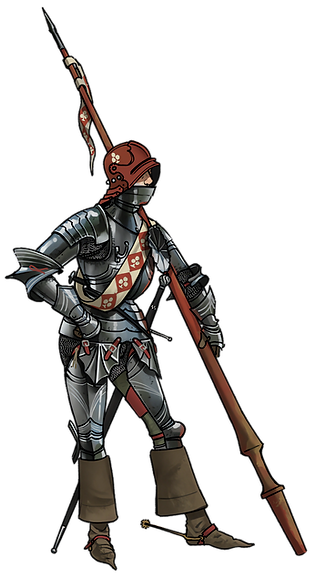
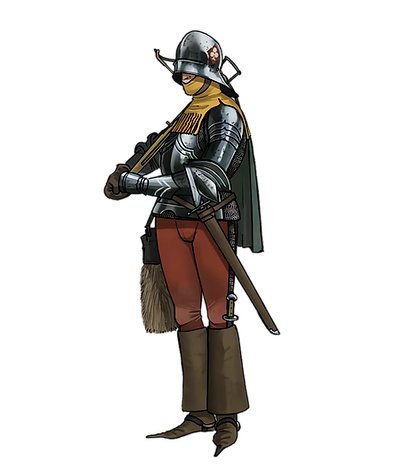
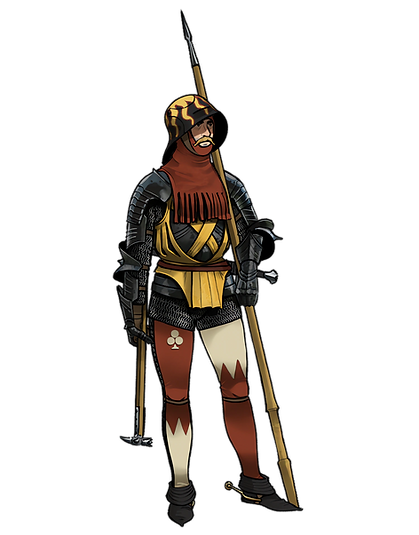
A Lidesbacher Knight, Light Cavalryman, and Mounted Crossbowman. The matching colours are just coincidence.