BREVIA-LANDAU
The Duchy of Brevia-Landau is an Imperial territory lying east of Pontz, bordered by Lidesbach to the north, Bodenburg to the southeast and Savobourg to the south. A wet country of rolling farmland, wooded hills and muddy valleys, it is neither particularly wealthy nor poor by the standards of the Empire.
The duchy takes its name from the former Counties of Brevia and Landau. Brevia occupied the eastern portion of the country, while Landau lay to the west along the Pontish frontier. The two were united through marriage and inheritance before eventually being elevated by the Emperor into the Duchy of Brevia-Landau. Their populations have since largely blended, although a minor Landish identity survives in the west.
The capital is Eltz, an old fortified city in historical Brevia and the traditional seat of its rulers. The city contains the ducal court and administration and serves as the principal centre of trade and manufacture within the duchy. The ruling House von Kesselried takes its name from Castle Kesselried, a major ancestral fortress northeast of Eltz toward the Lidesbach frontier.
Brevia-Landau is particularly associated with its soldiers. Its knights, men-at-arms, and kriegsknechte are frequently seen in squabbles, raids and skirmishes both in the duchy's long-running feud with Lidesbach and in support of Pontish campaigns. Brevian contingents commonly serve directly beneath Pontish commanders, earning them the derogatory nickname “Pontz's dogs” among their enemies.
The alliance between Brevia-Landau and Pontz is longstanding. Pontz gains a dependable source of experienced soldiers on its eastern frontier, while Brevia-Landau benefits from the support of a powerful neighbour against Lidesbach and other rivals. Repeated military cooperation and dynastic marriages have strengthened the relationship, and Brevia-Landau maintains considerably closer ties with Pontz than with the Imperial court. Hostility toward Lidesbach is equally longstanding. When the former ruling line of Brevia failed, both House von Kesselried and the rulers of Lidesbach advanced claims to the county. The Emperor ultimately invested the von Kesselrieds with Brevia, but Lidesbach disputed the settlement. The resulting succession struggle developed into generations of feuding and border warfare that continue to shape relations between the two territories even after a few hundred years.
The present ruler is Götz von Kesselried, Duke of Brevia-Landau, an elderly (66) and experienced soldier who fought against Lidesbach both as his father's heir and during his own reign. His second daughter is married to John d’Ault, Prince and Duke of Pontz, further strengthening the relationship between their houses. Relations with Bodenburg remain neutral, while those with Savobourg are generally cordial.
Brevian settlements are characterized by steep-roofed timber and masonry buildings suited to the country's frequent rain and heavy snowfall. Towns and villages are surrounded by cultivated fields, pasture and managed woodland, while castles and fortified residences are common throughout the countryside. Eltz is dominated by its ducal castle, while Castle Kesselried remains an important stronghold guarding the approaches from Lidesbach.
The arms of Brevia-Landau preserve those of its two former counties. The old arms of Brevia, three black lions upon gold, are joined with those of Landau, a field of red-and-white diagonal stripes divided by a broad black pale. Together they remain a visible reminder of the two territories from which the modern duchy was formed.
Local Superstition: Threshold Sign
When entering another's home for the first time or in times of strife or sorrow, Brevians traditionally touch the threshold or doorframe with their right hand (sword hand) and make the Sign of the Sun, blessing the household and signifying that they enter beneath its roof in peace.
Local Festival: Lantern's Eve
Each autumn equinox, as the days shorten, Brevians celebrate Lantern's Eve. At dusk, households place burning lanterns or candles outside their door or in a foremost window. Whole towns then remain brightly lit into the late evening with markets, dancing, music, food, drink and visits between neighbours. The lights represent the Diurnity's light enduring through the approaching dark months, though many traditions surrounding the festival are believed to be considerably older.
THE IMPERIAL DUCHY OF BREVIA-LANDAU

The Territorial Arms of Brevia-Landau

Political Map of Brevia-Landau
Capital
and largest city
Eltz
Official Language
-
High Kernish (Early New High German)
Common Languages
-
Common Vernacular (Modern English)
-
Pontish Kernish (Fictional Dialect)
-
Low Kernish (Middle Low German)
Government
Hereditary Feudal Duchy
Reigning Lord
Götz von Kesselried
Titles
Duke of Brevia-Landau, Count of Brevia, Count of Landau, Lord of Kesselried
Religion
Church of the Divine Diurnity
Denomination
Imperial Diurnism
Demonym
Brevian
Currency
Imperial Gilschen
Calendar
Imperial Calendar
Date: 1475
Notable Cities & Fortifications
Aicheldorf
Castle Kesselried
LIFE IN BREVIA-LANDAU
Food & Drink
Ordinary Brevian food is plain, filling, and heavily dependent on what can be produced locally. Rye and oat breads, barley porridge, pork, sausages, cabbage, onions, beans, eggs, cheese, and preserved meats are common throughout the duchy. Apples, pears, and other orchard fruit are widely eaten in season, while woodland communities make greater use of mushrooms, nuts, game, and smoked meat.
Ale is the ordinary drink in most households and taverns. Wine is available, particularly through trade with Pontz and in parts of western Landau where small vineyards exist, but it is much less central to everyday life than it is across the Pontish border.
Work & Trade
Brevia-Landau remains predominantly rural. Farming, livestock raising, forestry, charcoal burning, milling, carting, and seasonal labour provide livelihoods for much of the population. Pigs are commonly driven into woodland for pannage, while cattle and sheep are important both for household use and local trade.
The duchy's long military tradition also supports armourers, smiths, farriers, leatherworkers, crossbow makers, fletchers, and other trades concerned with equipping soldiers and horses. Eltz is an important centre of this work, though such trades can be found throughout the Gottesreich.
Road transport is especially important. Brevia-Landau possesses no great navigable river, so goods move largely by wagon, pack animal, and horse. Carters, drovers, innkeepers, toll collectors, bridge keepers, and labourers employed repairing roads are therefore familiar figures throughout the duchy.
Language & Speech
Brevians speak High Kernish, although speech in western Landau retains some regional differences and occasional Pontish or southern influence. A surviving Landish identity remains strongest in the west, particularly among older families, but most inhabitants consider themselves Brevian regardless of which side of the old county boundary they inhabit.
Brevian speech has a reputation for being direct and economical. Elaborate courtesies are less valued than saying plainly what one means, and excessive boasting or flowery speech is generally poorly received. This should not be mistaken for deliberate rudeness; Brevians simply tend to place greater value on straightforwardness than ceremony.
Courtesy & Etiquette
Hospitality tends to be practical. A traveller arriving wet or muddy may be given somewhere to dry a cloak before anything else, and refusing reasonable shelter during severe weather is considered particularly mean-spirited. Food placed before a guest is usually simple but generous where the household can afford it.
Mud is an unavoidable part of Brevian life, and there is little shame attached to arriving dirty from the road. Tracking that mud unnecessarily through someone else's home, however, is another matter. Scraping one's boots before entering and leaving wet outer garments near the door are ordinary courtesies.
Everyday Religion
Brevian Diurnism is generally conventional, with parish churches, village bells, roadside shrines, and household devotions forming part of everyday life. The Threshold Blessing is the most obvious regional expression of religion, although Brevians do not regard it as formal Church doctrine.
Weather shapes ordinary religious habits as much as doctrine does. Farmers pray for favourable planting and harvest weather, travellers commonly make the Sign of the Sun before setting out in heavy rain, and storms severe enough to threaten crops or buildings may bring villagers into church outside ordinary services.
Bells are especially important in scattered rural communities. A parish bell may carry farther than a person's voice ever could, marking worship, deaths, emergencies, and the passing hours across farms, fields, and woodland.
What a Brevian Knows
Someone raised in Brevia-Landau would normally recognize the arms of House von Kesselried and those of the principal lesser nobles in the surrounding district. Even common villagers usually know which lord controls nearby woodland, mills, bridges, roads, or grazing land, because such rights affect everyday life directly.
A Brevian would also know which roads become nearly impassable after prolonged rain, where nearby streams may safely be forded, how to judge whether a loaded cart is likely to bog down, and which stretches of woodland belong to whom. Many rural people become skilled at recognizing signs of approaching bad weather simply because failing to do so can ruin a day's work.
The old distinction between Brevia and Landau is common knowledge as well. Even people with little interest in history generally know which side of the former boundary their village lies upon and whether neighbouring families consider themselves particularly Landish.
Ordinary Troubles
The problems encountered by ordinary Brevians are often concerned with land, roads, animals, and local rights. Washed-out bridges, flooded lanes, livestock straying into another man's field, illegal woodcutting, poaching, disputed grazing rights, unpaid tolls, and arguments over mills or watercourses are all familiar sources of trouble.
The duchy's numerous lesser nobles create another layer of local friction. Boundaries between estates, hunting rights, debts, inheritance disputes, and old grudges between neighbouring knightly families can easily draw villages and retainers into quarrels that have little to do with the Duke himself.
The feud with Lidesbach intrudes periodically upon life near the northern frontier. Even in peaceful years, travellers may encounter patrols, suspicious toll officials, damaged boundary markers, livestock theft, or arguments over whether a particular field, wood, road, or stream properly belongs to one side or the other.
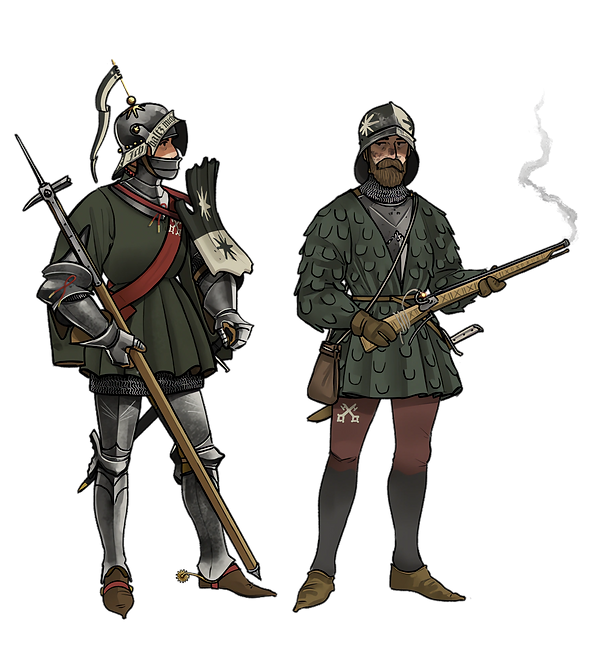

A pair of Brevian knights and a gunner, each wearing the crossed keys of Pontz as a livery symbol denoting military service under the Prince of Pontz.