BODENBURG
The Duchy of Bodenburg is a prosperous southern state of the Gottesreich, known for its orderly administration, productive countryside, and extensive trade in steel, arms, and armour. Its capital, Bodenburg, is among the better-known manufacturing centres of the region and gives its name to the duchy as a whole.
Bodenburg is ruled by Albrecht von Riedern, Duke of Bodenburg, a cautious and methodical Duke in his early fifties. Albrecht is less interested in military glory than in stable revenues, dependable administration, productive towns, and the maintenance of trade. Much of Bodenburg’s reputation for order predates his reign, though he has worked to preserve and strengthen it.
The people of the duchy are known as Bodenburgers.
LAND AND ECONOMY
Bodenburg is a comparatively fertile and well-settled land of cultivated valleys, market towns, estates, roads, mills, and river crossings. Agriculture remains important throughout the countryside, supporting grain, livestock, and local market trade.
The capital is the duchy’s greatest source of wealth and reputation. Bodenburg is particularly well known for its steel, arms, and armour. Its smiths, armourers, and weaponsmiths produce reliable work in considerable quantity, much of it intended for export elsewhere in the Gottesreich.
The trade supports a broad network of associated craftsmen, including grinders, polishers, leatherworkers, merchants, and wagoners. Finished armour, weapons, steel plate, and other metal goods form an important part of the duchy’s wealth and have given Bodenburger workmanship a strong reputation beyond its borders.
GOVERNMENT
Bodenburg has a reputation for competent and predictable government.
Albrecht von Riedern takes particular interest in taxation, roads, tolls, trade, and the privileges of the towns and guilds. He is known to favour careful record-keeping and regular administration over dramatic reforms or displays of ducal authority.
The manufacture of arms and armour is closely tied to ducal interests. Guild privileges, workshop standards, export rights, and disputes between craftsmen and merchants are therefore treated as matters of considerable importance.
This attention to administration has made Bodenburg comparatively stable and prosperous, though neighbouring dukes sometimes regard its court as overly cautious and concerned with accounts.
ALBRECHT VON RIEDERN
Albrecht von Riedern, Duke of Bodenburg, is a restrained and pragmatic ruler who prefers negotiation and careful preparation to unnecessary confrontation.
He is neither particularly warlike nor politically ambitious beyond the interests of his own duchy. Albrecht generally avoids becoming entangled in the feuds of neighbouring states unless Bodenburger interests are directly threatened.
His relations with Soderlingen are good, while his dealings with Brevia-Landau are generally neutral and practical. He is respectful toward the Emperor but is not counted among the closest members of the Imperial court.
Other rulers may find Albrecht somewhat unexciting, but few consider him unreliable.
MILITARY
Bodenburg maintains conventional kriegsknechte and town militias rather than any particularly unusual military tradition.
Its wealth allows it to equip soldiers well, and access to the capital’s armourers and weaponsmiths means that good-quality arms and armour are comparatively easy to obtain within the duchy.
Bodenburger forces include men-at-arms, cavalry, crossbowmen, Kriegsknechte, and town militias, supported by the craftsmen and supply networks of the capital.
The duchy’s military reputation rests less upon flamboyant battlefield traditions than upon equipment, organization, and dependable supply.
REGIONAL CHARACTER
Bodenburgers are often stereotyped as practical, orderly, and commercially minded.
Towns are comparatively prosperous, roads and bridges are maintained carefully, and merchants and craftsmen occupy an important place in civic life. Skilled workmanship carries considerable prestige, particularly in the capital, where families involved in steelworking, arms manufacture, and armour production may accumulate substantial wealth.
The duchy’s culture is generally less ostentatious than Soderlingen and less martial than Brevia-Landau. Bodenburgers tend to take pride instead in dependable work, stable trade, and the belief that things function as they ought to.
THE IMPERIAL DUCHY OF BODENBURG

The Territorial Arms of Bodenburg
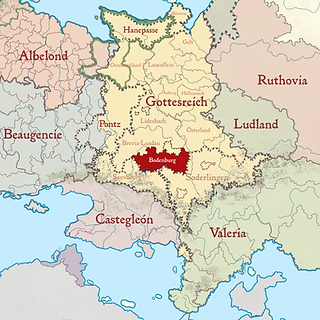
Political Map of Bodenburg
Capital
and largest city
Bodenburg
Official Language
-
High Kernish (Early New High German)
Common Languages
-
Common Vernacular (Modern English)
-
Low Kernish (Middle Low German)
Government
Hereditary Feudal Duchy
Reigning Lord
Albrecht von Riedern
Titles
Duke of Bodenburg
Religion
Church of the Divine Diurnity
Denomination
Imperial Diurnism
Demonym
Bodenburger
Currency
Imperial Gilschen
Calendar
Imperial Calendar
Date: 1475
Notable Cities & Fortifications
Wimpffen

The Arms of the City of Bodenburg